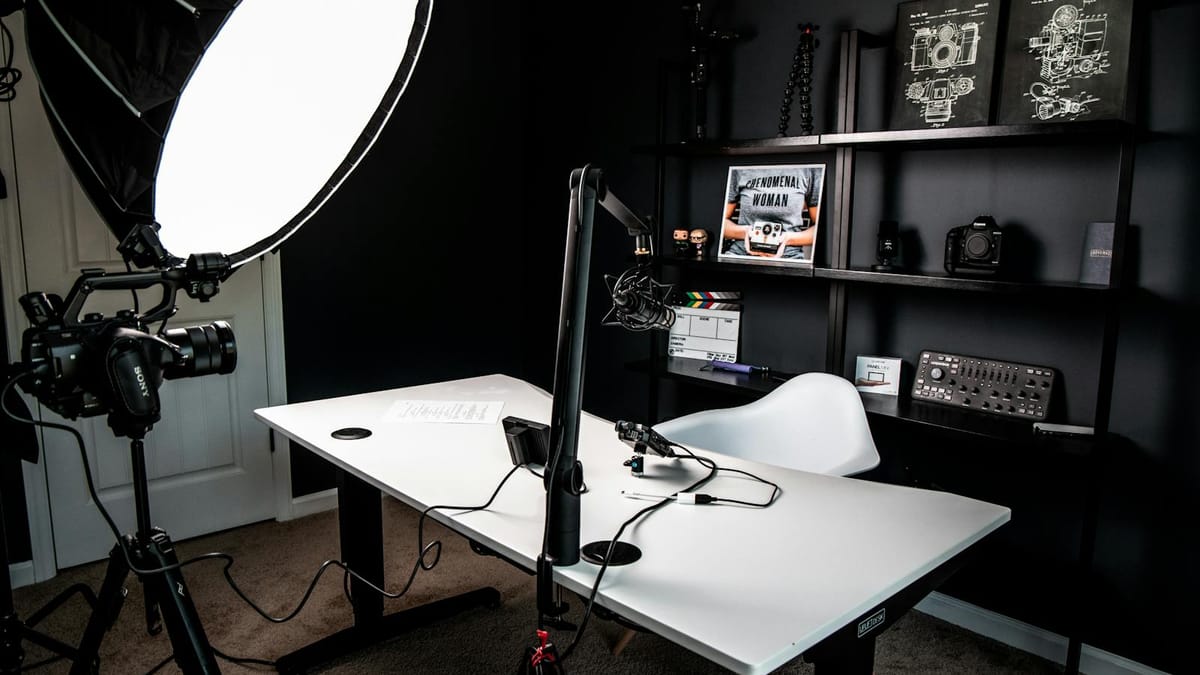
For a full-time creator, the hard part isn't making content — it's that ad revenue, sponsorships, affiliate income and merch land in different currencies, on different schedules, with no single entity behind them. A Hong Kong company can consolidate all of it into one credible structure taxed on profits at 8.25%/16.5%, set up remotely from HK$3,895. Whether it fits depends on your scale and where you're tax-resident.
If you make your living on the internet, your "business" probably looks like a browser with fifteen tabs open. One platform pays out ad revenue every month in US dollars. A brand wires a sponsorship fee in euros. An affiliate dashboard drips commission in a third currency. A print-on-demand partner sends merch royalties on its own cycle. You invoice the occasional brand deal as yourself, get paid into a personal account, and at tax time you try to reconstruct the whole thing from email receipts and payout statements. It works — until it doesn't.
At a certain point the question stops being "how do I grow the channel?" and becomes "how do I run this like an actual business?" That's where a lot of creators start looking at Hong Kong: a reputable, low-friction jurisdiction where you can pool every income stream into one company, sign brand contracts as an entity rather than a person, hold your channel name and trademarks properly, pay your editor without it being a personal favour, and be taxed on profit instead of gross. Below we map exactly how a Hong Kong company helps each kind of creator income, where it genuinely fits, and the two caveats that matter most. Here's the scannable version first.
| Your creator income stream | How a Hong Kong company helps |
|---|---|
| Platform ad revenue (YouTube, TikTok, etc.) | Payouts land in one company account instead of your personal one — clean records, and revenue sits inside an entity you can deduct costs against. |
| Brand sponsorships & deals | Sign and invoice as a company, not as yourself. A limited company on the contract reads as a real business to brand legal teams and looks credible on a media kit. |
| Multi-currency payouts | A Hong Kong company opens multi-currency business accounts (USD, EUR, GBP and more) so USD ad revenue and EUR sponsorship fees stop bleeding margin to forced conversions. |
| Merch & affiliate income | Print-on-demand royalties and affiliate commissions flow into the same entity — one set of books, one profit figure, instead of a dozen scattered dashboards. |
| Paying editors & VAs | Pay your editor, thumbnail designer or virtual assistant from company funds as a documented business cost — deductible against revenue, not money leaving your personal account. |
| Holding your brand & IP | The company can own your channel name, logo, trademarks and content library — so the brand is an asset of the business, not informally tied to you personally. |
The Creator's Structuring Question: When "Just Me" Stops Working
Almost every creator starts as a sole operator — paid personally, taxed personally, with no entity between them and the platforms. For a while that's the right call: it's simple, it's free, and there's nothing to administer. The structuring question only becomes real when the income gets big enough and tangled enough that running it as "just me" starts costing you money, credibility, or sleep.
The usual triggers are familiar to anyone who's hit them. Brand deals start landing where the sponsor's legal team wants to contract with a company, not an individual. Payouts arrive in three or four currencies and your bank quietly skims every conversion. You're paying an editor and a designer every month but it all comes out of your personal account, so the line between "my money" and "the business's money" has vanished. And the tax bill on your gross income is starting to sting because you're being taxed on what you earn, not on what's left after the very real costs of producing content.
A Hong Kong company answers that by giving the business its own legal identity — separate from you. It earns the revenue, holds the assets, pays the costs, and is taxed on its profit. If you're trying to work out whether you've actually crossed that threshold, our guide on who a Hong Kong company is actually right for lays out the fit test in plain terms before you spend a dollar.
Consolidating Global Income Into One Credible Entity
The single biggest practical win for a creator is consolidation. Right now your income is probably spread across platform dashboards, an affiliate network, a merch partner and a handful of one-off brand invoices — each with its own login, its own payout schedule, and its own currency. There's no single place that says "this is what the business earned this year." A Hong Kong company becomes that place.
Every stream points at one entity. Platform ad revenue, sponsorship fees, affiliate commissions and merch royalties all land in the company's multi-currency business account, which can hold and receive US dollars, euros, sterling and more without forcing a conversion on every deposit. That alone matters: a creator earning USD ad revenue and EUR brand fees can easily lose a few percent of everything to forced FX if it all dumps into a single-currency personal account. Holding the currency until you actually need to convert is money straight back in your pocket.
It also changes how the outside world sees you. A brand's procurement team would far rather raise a purchase order to Your Media Limited than wire a five-figure fee to an individual's personal account — it's cleaner for their compliance and it signals they're dealing with a real operation. Hong Kong's status as a long-established, transparent financial centre, with a public framework you can verify on the Companies Registry, means the entity carries weight on a contract — not the raised eyebrow that some offshore labels attract. The banking step is the part that takes real preparation rather than luck; our team prepares the know-your-customer file and introduces you to our digital and traditional banking partners as part of the Hong Kong incorporation package.

Holding Your Brand & IP — and Paying Your Team Properly
As a channel grows, two things quietly become valuable: the brand itself, and the team behind the scenes. A Hong Kong company gives both a proper home. The company can own your intellectual property — the channel name, the logo, registered trademarks, your back catalogue of content, even the domain and the email list. Instead of all of that being informally attached to you as a person, it sits as an asset on the business's books. That matters if you ever bring on a partner, license your format, take on a manager, or one day sell the brand: the thing being valued is owned by a clean entity, not tangled up with your personal affairs.
The team side is just as practical. Most creators reach a point where they're paying an editor, a thumbnail designer, a scriptwriter or a virtual assistant every month — often scattered across the world. Run through a company, those payments are straightforward business costs: the company contracts the freelancer, pays them from company funds, and the cost is deducted against revenue before profit is calculated. That's a world away from paying contractors out of the same personal account your salary lands in, with no record of what was a business expense and what was your grocery money.
One important guardrail: paying overseas contractors from a Hong Kong company is paying for a service, not running a local payroll — but how you draw money out of the company, and how your contractors are taxed where they live, are separate questions that depend on each person's own country. Keep the company's side clean and documented, and confirm the personal side locally. The bookkeeping behind all of this — logging every payout, every cost, every contractor invoice — is exactly what our accounting and audit service handles, so the records are audit-ready without you living in a spreadsheet.
Tax on Profits, Not on Gross — How Hong Kong Treats Creator Income
Here's the part creators tend to find genuinely appealing, and it's worth being precise about. Hong Kong taxes profits, not turnover. Your legitimate costs of producing content — your editor, your gear, software subscriptions, the percentage of your home studio you use, travel for shoots — come out before any tax is calculated. You're taxed on what the business actually keeps, not on the gross that hits the account.
The headline rate is a two-tier profits tax: 8.25% on the first HK$2 million of assessable profits and 16.5% on profits above that, per the Inland Revenue Department. There is no VAT or GST in Hong Kong and no capital gains tax — two costs creators often brace for and simply don't meet here. For a profitable creator business, being taxed on net profit at those rates rather than on gross income is frequently the headline reason to incorporate at all.
Now the caveat that matters most, and we'll say it plainly: your personal tax residency still matters. A Hong Kong company is taxed in Hong Kong, but where you live and are tax-resident has its own rules about money you draw from a foreign company, and many countries look closely at companies controlled by their residents. That is entirely outside Hong Kong's lane and outside our remit — we will not guess at your home country's treatment. What we stand behind is the Hong Kong side: the company, its profits tax, its filings. The personal side you must confirm with a qualified advisor where you are tax-resident, before you assume any particular outcome. Anyone promising you automatic zero tax because the company is "offshore" is selling you a problem, not a solution.
When It Fits — and When It's Premature
A Hong Kong company is a tool, not a trophy. It earns its keep for some creators and is pure overhead for others. The honest dividing line is about scale, complexity, and how global your income already is. Run yourself against this checklist before you decide.
You're full-time (or nearly) and the income is consistent — not a side hustle you're testing.
Your income spans multiple platforms, sponsors and currencies, and consolidating it would genuinely simplify your life.
Brands increasingly want to contract with a company, and a credible entity would unlock or smooth deals.
You're paying editors, designers or VAs regularly and want those as clean, deductible business costs.
You've checked your personal tax-residency position locally and understand how drawing income from a foreign company works for you.
Premature if: you're pre-revenue or earning pocket money, all your income is one currency from one platform, or you're chasing a "zero-tax offshore" promise.
If you tick most of the green boxes, the structure is doing real work for you. If you're still in the testing phase or your whole income is one stream in one currency, incorporating early just buys you annual compliance you don't need yet. There's no prize for setting up too soon — the moment to move is when the admin and credibility gains clearly outweigh the running cost.
The Cost, and What Our Package Covers
Creators usually assume "Hong Kong company" is an expensive, complicated thing. The government cost to incorporate is modest and entirely public — there's no mystery to it.
Government cost to incorporate: HK$3,895 — HK$1,545 Companies Registry electronic fee + HK$2,350 Business Registration (incl. the HK$150 levy reinstated 1 April 2026). One transparent fee to us; no markup on government rates, and your company is typically formed in 3 to 5 working days.
That HK$3,895 breaks down as the HK$1,545 Companies Registry (CR) electronic incorporation fee plus the HK$2,350 one-year Business Registration (BR) certificate, which includes the HK$150 levy reinstated on 1 April 2026 after a two-year waiver. You can confirm the framework on the government portal. Our incorporation package covers all of it — we file every form with the CR and the Inland Revenue Department, and we provide the statutory company secretary and a registered office address in Hong Kong from day one, both of which Hong Kong law requires. The whole thing is done remotely; you never need to set foot in Hong Kong to set up or run the company.
Where creators should keep a clear head is on the ongoing cost, not the setup. A Hong Kong company carries an annual rhythm — BR renewal, the company secretary and registered office, plus accounting and an audit by a Hong Kong CPA — and that's the real budget line. We run all of that as ongoing service so the compliance dates land in our inbox, not yours. The model is the same one we walk through for adjacent creator businesses; if you also sell courses or coaching alongside your content, our companion guide on a Hong Kong company for coaches and course creators covers that overlap.
Benchmark the Safe Patterns
The creators who get this right tend to follow a few sensible patterns rather than chasing aggressive ones. They incorporate when the income is real and consolidation genuinely helps — not on day one of a channel. They keep the company's books clean and current, so the annual audit is a non-event rather than a scramble. They pay their team and their costs through the company and keep the receipts. They treat the brand and IP as company assets from the start, so nothing has to be untangled later.
And — most important — they keep the two sides separate in their heads: the Hong Kong company's tax position is one thing, and their own personal tax residency is another, confirmed with a local advisor and not assumed. The creators who run into trouble are almost always the ones who skipped that second step because someone sold them a "tax-free" headline. The structure is legitimate and powerful when used honestly; it's a liability when used to dodge a question you should have answered at home.
If you're a full-time creator weighing this up, the fastest way to know whether it fits is a short conversation about your specific situation — your platforms, your income mix, where you're tax-resident, and what banking will realistically look like for you. Speak with our Hong Kong team for a free consultation, and we'll tell you honestly whether a Hong Kong company is the right move yet.
The Bottom Line
For a full-time creator earning across platforms, sponsors and currencies, a Hong Kong company can pull the whole scattered picture into one credible entity — consolidating ad revenue, sponsorships, affiliate and merch income into multi-currency accounts, holding your brand and IP, paying your editors and contractors as clean business costs, and being taxed on profit at 8.25% and 16.5% rather than on gross, with no VAT or capital gains tax. Setup is remote and the government cost is HK$3,895.
It fits when the income is real, global and tangled enough that consolidation and credibility outweigh the annual compliance — and it's premature when you're still testing or earning one currency from one platform. The one caveat to never skip: your personal tax residency has its own rules, so confirm that locally before you assume any outcome. When the structure fits, we handle the incorporation, the company secretary and registered office, the banking introductions and the ongoing accounting — so you can get back to making the content.